The Workforce Has Shifted: Why Burnout, Workplace Stress, and Leadership Matter More Than Ever
For years, many leaders operated under a simple assumption: most employees were doing okay, and only a small percentage were truly struggling.
For a long time, the data supported that belief.
But something has changed in the last few years.
A Turning Point in Workplace Wellbeing
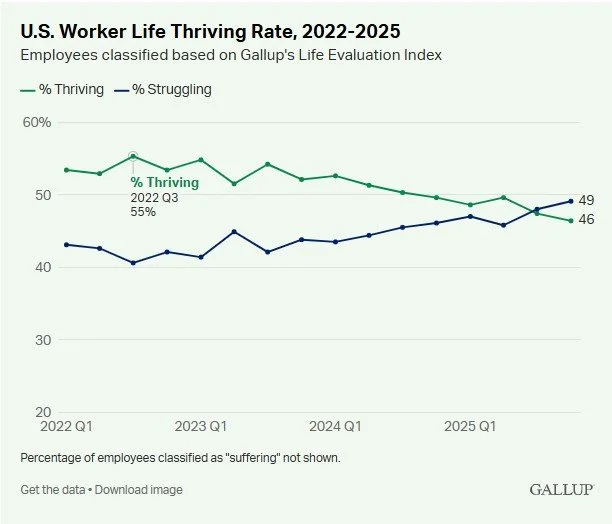
Until 2022, data from Gallup consistently showed that a majority of U.S. workers described themselves as thriving, while a smaller percentage reported struggling or suffering in their lives and work.
By 2023, when I began speaking more frequently on workplace burnout and employee wellbeing, those lines were moving in the wrong direction—fast.
They were on track to cross for the first time.
And now, they have.
In 2026, more U.S. workers report that they are struggling or suffering (54%) than thriving (46%). That’s not just a statistic. It’s a signal of a workforce under sustained pressure.
Burnout, Job Dissatisfaction, and a Stuck Workforce
The implications go beyond engagement scores.
More than half of U.S. employees are actively looking for a new job
Yet only 28% believe it’s a good time to find a quality job
Workers feel stuck, discouraged, and increasingly burned out
This is where workplace burnout, job dissatisfaction, and chronic stress collide.
Employees aren’t just unhappy. They are trapped.
And that creates a dangerous combination for organizations:
low morale, declining productivity, disengagement, and high turnover risk.
Why Traditional Solutions to Burnout Are Falling Short
So how are many organizations responding?
Perks.
Pizza parties. Bonuses. Small morale boosters.
To be clear—compensation and appreciation matter. No one is turning those down.
But they are not solving the core problem.
Burnout is not a pizza problem.
And it’s not primarily a pay problem.
It’s a leadership and workplace culture problem.
The Real Solution: Leadership Development and Workplace Culture
If the workforce has changed, leadership must change with it.
Today’s employees need more than direction—they need support, clarity, psychological safety, and leaders who understand the human side of work.
That means investing in leadership development, emotional intelligence, and people-first management skills.
Managers are not just task supervisors anymore. They are culture carriers.
They have the greatest influence on whether employees:
feel supported or isolated
stay engaged or mentally check out
remain in their role or start planning an exit
When you improve leadership, you improve the entire system.
The Overlooked Reality: Leaders Are Burned Out Too
There’s another layer many organizations miss:
Leaders themselves are struggling at similar levels.
They are navigating:
increased expectations
constant change
emotional load from supporting their teams
pressure from senior leadership
This is why leadership development has a double impact:
it supports the leader and every employee they manage.
Building a Workplace Where Employees Can Thrive Again
If more than half your workforce is struggling, incremental fixes won’t work.
Organizations that want to stand out—those that want engaged, loyal, and thriving employees—must take a different approach.
They must:
prioritize workplace wellbeing
invest in leadership skills, not just technical skills
create psychologically safe and supportive environments
treat burnout as a systemic issue, not an individual weakness
The organizations that do this well won’t just survive this shift.
They’ll become the exception.
A Different Kind of Workplace Is Possible
Right now, most organizations are dealing with a workforce that feels burned out and stuck.
But it doesn’t have to stay that way.
With the right leadership development strategy, you can create a workplace where people:
feel valued
stay engaged
and actually thrive
If you’re ready to invest in your leaders and build a healthier, more sustainable workplace culture, let’s talk.
Want to go deeper?
You can explore the full data and trends directly on Gallup’s site.