Spiders, Systems, and Good Intentions
I don’t have anything against spiders, personally.
They have a job to do. I respect that.
However, I have a job to do as well.
That job? Keeping a clean porch.
Are you already anticipating our epic battle? My years-long struggle included daily knocking down webs near my front door.
These are hard-working spiders–able to create massive webs in 24 hours.
Jokes on them, though. I can clean up the corners nightly with a swipe of the broom.
It only takes me a few minutes. Of course, it required my repeated attention.
These daily skirmishes continued every summer for longer than I’d like to admit.
Then, one day, I stopped to think.
“What’s my goal?” A clean porch.
“Is this method effective?” Somewhat. The webs were cleared momentarily, but eventually they returned.
“Was it a good use of my time?” Apparently not, since they keep coming back.
“Were my intentions good?” Yes. I wanted to have a clean porch.
“Didn’t the spiders learn that this isn’t a good place for webs?” Apparently not.
“Why did they keep building webs?” To eat, of course.
“What made this a good place to build a web?” Ah, I was getting somewhere.
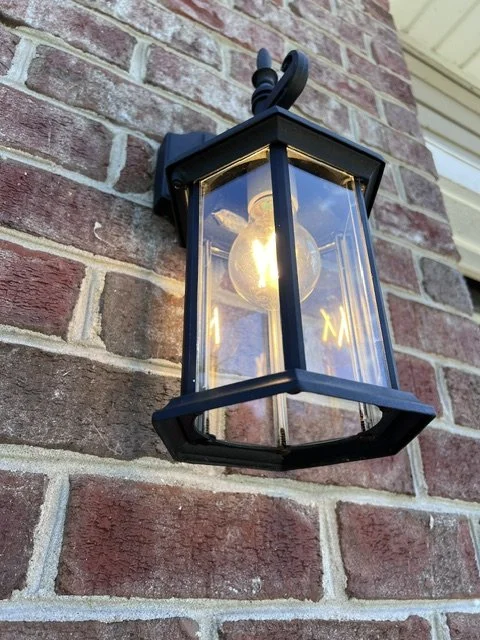
The porch light. The one I kept having to clean. It attracts their prey–insects.
So, one night, before I stepped outside to knock down the spider webs yet again, I paused. A light dawned on me. I looked over at the panel of switches just inside my dirty front door.
There were three that controlled external lights in front of my house. One for the light post. Another controlled the lights on either side of the garage door. And the final was dedicated to the single light on my front porch. The beckoning call to the moths and other insects that inspired the spiders to rebuild their webs.
I needed to change the system.
So… wait for it… I turned off the light next to my front door.
The next day, there were still spider webs.
No one said spiders are fast learners.
I knocked them down. And left the porch dark again that night.
Fewer webs the next morning.
Now, a few years on, I always leave that light off. And the spiders have all moved on to better hunting grounds.
My intentions and goals are still the same–a clean porch.
The outcome has improved–the porch is cleaner.
My effort, although it wasn’t great to begin with, has been reduced to zero.
This is the difference between having a leader who wants to support the wellbeing of their team and having a system that supports their wellbeing.
Stick with me.
A supportive leader will take supportive actions routinely. Maybe daily–just like I did when I was knocking down the webs.
They will work hard to support their team.
Except when they are on vacation, or overworked, or sick, or simply in a meeting.
They will routinely knock down those webs. Their intention is good.
But the outcome? It’s spotty.
The effort? They would argue it’s worth it.
The felt effect? The coworkers feel supported–sometimes.
Systems are like turning off the porch light.
For example. Imagine that a supportive leader without systems in place learns that a coworker has experienced a death in their family. The leader calls them. Offers sympathy. Sends a card. Maybe attends the funeral. They are a good leader–knocking down webs often.
However, there are more holes in this approach than a piece of Swiss cheese.
What if the coworker never tells their leader about the death of the loved one?
What if the leader isn’t supportive?
What if the relation of the deceased doesn’t qualify for bereavement time?
What if the leader simply forgets to send the card, or check-in on the coworker, or go to the funeral?
What if, God forbid, the leader doesn’t like that coworker?
Or that coworker doesn’t like the leader?
Or the leader is out on FMLA when the death occurs?
The process of knocking down webs, although not labor-intensive, requires constant attention.
In this situation, what systems could equate to turning off the front porch light?
In my last workplace, we posted a bereavement form on our intranet site. It was simple and could be completed by the coworker or their leader. When they submitted the form, a notification was sent to HR and me (Chaplaincy Director).
The details were few. The name of the coworker. The name of the deceased. The relationship between the two. And the name of the coworker’s leader.
Next, HR automatically initiated a memorial gift. Over the years, the gifts varied from wind chimes, a memorial plaque, or a donation to the health system foundation to honor the deceased.
Simultaneously, an email landed in my inbox. I created Outlook rules to funnel these messages into a special folder.
Once a week, I sent emails to these coworkers. I expressed support, and offered resources.
Admittedly, I used a copy and paste message, although I often customized it slightly.
The email explained some of the other systems we had in place.
Support groups. EAP counselors. Grief materials in our chaplaincy office, and real live chaplains in every facility.
Over time, I developed a second email that I sent to the leader. The leader's email gave them tips on how to respond as their coworker was grieving.
Sometimes, the grieving coworker had a supportive leader and team. Those coworkers often replied to my email praising their “work family” for being there for them in their time of need.
Other times, the reply was more grim. “At least someone acknowledged what happened. I had to fill out the form myself.” Imagine if the system had not been in place. Their anger would have multiplied.
But we turned off the porch light.
At a basic level, we never missed showing support to our coworkers (in a huge health system) when their loved ones died.
This principle can be applied to everything from quality and compliance to the mental health of coworkers.
A few other examples:
A leader who always reminds their direct reports to maintain quality standards vs. Tools that make it nearly impossible to miss required documentation
A leader who supports the use of EAP counselors vs. A department practice of requiring an EAP visit after 90 days of employment
A leader who cares about the personal vitality of their coworkers vs. A routine of dedicating five minutes at each staff meeting to discuss mental health
Turn off the light.
I know you don’t mind knocking down the webs.
You’re committed.
Your intentions are good.
But the outcome is spotty.
Just. Pause. And find the light that needs to be turned off.
It might take more effort than leaving my front porch light off (which takes no effort). But once systems are in place, they work day and night. Make sure their work lines up with your intentions.
Good systems defeat good intentions every minute of every day.