Blog
Leadership, Burnout,
and the Realities of Work
Practical posts drawn from healthcare leadership,
coaching, and real-world experience.
Enjoy!
Enjoy vs. Consume.
I am drinking a cup of coffee. Am I enjoying it? Or simply consuming it?
How many times have I have finished a drink, a meal, a conversation, or an entire day...
Only to realize I can barely remember a single sip, bite, or moment?
Slow my pace.
Quiet my mind.
Appreciate this moment.
Enjoy with all my heart.
These four phrases have instructed me (with varying success) for more than a decade.
Why?
Because I naturally do the opposite.
Left unchecked, I will:
Hurry my pace.
Busy my mind.
Consume my time.
Resent my life.
Because of this framework, I have come to believe that the primary indicator of my own mental health is--am I enjoying?
Or am I simply consuming?
When I am on stage for a keynote--am I enjoying? Or simply trying to be polished?
When I am with my wife--am I savoring our love and conversation? Or is my mind busy with other thoughts?
When I am writing--am I engaging deeply with the words, or simply trying to finish the email or post?
For many years, as an evangelical pastor and bible scholar, I focused on spiritual disciplines--and right living.
Then, Richard Foster's "Celebration of Discipline" revealed that the goal of being disciplined and responsible is... wait for it... JOY.
As an Enneagram One, I naturally overemphasize responsibility and doing the right thing.
On my good days, though.
I enjoy.
I play.
I savor.
I practice the lessons that my friend, Dr. Dave Johnson, has taught me about being mindful.
Consuming and an overemphasis on responsibility drive me to obsession and fear.
Enjoyment and play drive me to... well, actually loving life and not being such a tool.
Not everything can be enjoyed, of course.
But what if our life's litmus test was our response to this question:
"What have I enjoyed today?"
9 Real-World Ways Leaders Reduce Moral Distress (Without Adding to the Budget)
Most leaders care about their teams. They just don’t always know how to help when the problem isn’t workload, but moral distress.
Moral distress happens when people know what the right thing is, but can’t do it because of staffing shortages, policy, paperwork, or pressure to move faster. It’s common in healthcare, social services, education…and anywhere that humans care for other humans.
You don’t need a bigger budget to make things better. You need clarity, conversation, and a culture where it’s safe to tell the truth about what’s not working.
Here are practical, real-world ways leaders are reducing moral distress on their teams right now.
1. Hold “Say the Quiet Part Out Loud” Moments
Near the start of meetings, ask one question:
“What is everyone thinking, but not saying?”
If your team trusts you, you’ll learn more in 60 seconds than an anonymous survey will ever tell you. If it’s silent—you’ve got deeper problems.
2. Repeat the “Why”
Sometimes at work we are so focused on what we can forget about why. Leaders need to repeat the reasons why certain tasks are important. This connects daily actions to the mission of the organization and fuels a sense of meaning and purpose.
It also helps new staff understand how you make choices.
3. Protect Time for Real Work
Block off one uninterrupted hour every week and label it “clinical judgment,” “planning,” or “deep work.”
When leaders defend that time, it signals that thinking and care are just as valuable as productivity.
4. Create a Clear Escalation Path
People experience moral distress when they don't know how to speak up about unsafe or unethical situations.
Make it clear: Who do we tell? In what order? How quickly is it addressed? If someone speaks up, what happens next? Document it and repeat it often.
By default, coworkers are afraid to blow the whistle. Leaders have to make it easy—and safe.
5. Ask Better Check-In Questions
Skip “How’s everybody doing?” Instead try:
What is getting in the way of doing your job the way it should be done?
What is one thing making work harder than it needs to be?
What’s a decision we’re avoiding?
These questions get honest answers faster.
6. Give Permission to Pause
In healthcare, education, and other high-stakes environments, people often push through distress to “get the job done.” Create a script like:
“If you need a minute, take it. I’ll cover you.”
This tiny act of teamwork can prevent burnout, mistakes, and regret.
7. Rotate “Emotional Load” Roles
Some staff always end up comforting families, calming angry patients, or supporting coworkers after trauma.
Rotating these roles—or giving those individuals recovery time—acknowledges the emotional cost of the work.
We must leave the culture of “suck it up” and “soldier on” in the past.
8. Close the Loop
If someone reports a concern, follow up. Even if all you can say is, “We’re working on it,” or “Here’s why it can’t change right now.”
Silence is what causes people to shut down. Even imperfect answers build trust.
9. Share the “Why” Behind the Mission Again
Burnout disconnects people from meaning. Moral distress disconnects them from purpose.
Remind teams not just what they do, but why it matters. Be specific. Tell a story. It works.
Want to Go Deeper?
These are topics I teach in leadership workshops, especially for healthcare and human service organizations. If your team needs practical tools and a shared language around burnout and moral distress, you can check my speaking availability here:
https://patrickriecke.com/live-presentations
Or explore ongoing videos, resources, and discussion guides inside The Burnout Hub:
Burnout Recovery Strategies: How a Bucket List Can Help You Heal and Thrive
Burnout drains us of more than just energy. It robs us of hope, purpose, and a sense of possibility. When you’re stuck in the fog of exhaustion, cynicism, and overwhelm, it’s hard to imagine anything different. That’s why burnout recovery strategies are so important and why one of the simplest and most surprising tools is a bucket list.
Most people think of a bucket list as something you write later in life, dreaming of trips around the world or adventures you’ll “someday” get to. But when it comes to burnout recovery, a bucket list takes on a new role: it becomes a roadmap for self-care, renewal, and joy.
Why a Bucket List Is One of the Most Overlooked Burnout Recovery Strategies
When you’re burned out, your brain slips into survival mode. You stop looking forward, and you lose the joy of imagining what could be. A bucket list interrupts that pattern and helps you recover from burnout by reconnecting you with your desires.
But, a lot of burned out, others-focused people have a hard time starting their list.
Don’t know where to start?
Use these three frameworks to start or add to your bucket list:
Aspirational goals – The big, inspiring dreams that remind you life is more than your current stress. Maybe you’ve always wanted to learn a language, write a book, or see the Grand Canyon. These goals give you hope and direction. One that’s still on my list is a European vacation.
Quick wins – The small, doable actions that create immediate sparks of energy and accomplishment. Something as simple as trying a new restaurant, planting flowers, or booking a day trip reminds you that you still have agency. These quick wins are essential because they restore momentum.
Milestones – These are things that are likely to happen whether or not they are on your list. One of mine was “teach our daughter to drive.” Even if it wasn’t on my list, I would have done it. But adding it to the list helped me reframe it as a joy instead of only a responsibility. BTW: I didn’t fake it. I actually wanted to do this, which is the only reason it works as a bucket list item.
How a Bucket List Re-Wires Your Burnout Story
A bucket list doesn’t just create fun activities, it rewires your narrative. Burnout says: “You’re stuck.” A bucket list says: “You still have choices.” Burnout whispers: “You’ll never get your energy back.” A bucket list replies: “Look what you’ve already done.”
Each time you check something off—big or small—you create evidence that life can be more than just surviving another workday. That’s why my attendees and clients consider it one of the most practical burnout prevention tips: it helps you build hope, one entry at a time.
Step-by-Step: How to Create a Bucket List for Burnout Recovery
You don’t need an elaborate plan. Grab a piece of paper, or open the notes app on your phone, and try these steps to start your personal bucket list for burnout recovery:
Dream big – Write down five aspirational goals you’ve always wanted to pursue. Don’t worry if they feel far away. They’re supposed to inspire you.
Start small – Add five quick wins you could do this week or this month. Keep them bite-sized and energizing.
Build toward milestones – Choose one or two future events that are likely to happen and recast them as bucket list items. Remember, they have to be things you are actually excited about.
Celebrate progress – Every time you check something off, pause. Notice the energy it gives you. Recovery is as much about recognition as it is about action.
Burnout Recovery Is About Living Again
At its core, burnout is a crisis of meaning and a loss of agency. A bucket list restores that meaning by helping you imagine, act, and celebrate again. It isn’t about escaping work—it’s about remembering that your life is more than work.
If you’re searching for burnout recovery strategies that actually work, start with a bucket list. Fill it with aspirational goals, quick wins, and milestones that pull you forward. And as you begin to check things off, notice what happens: joy creeps back in, hope rebuilds, and burnout starts to lose its grip.
👉 Looking for more practical burnout prevention tips? Explore my resources on burnout recovery and prevention in The Burnout Hub.
They are desperately crying for help
When you talk about burnout as openly as I do--these conversations are inevitable.
Once or twice a week, I find myself on the listening end of one of these conversations. The other person--spilling over with sadness, anger, or frustration about their jobs.
They aren't complaining. They are desperately crying for help.
"And then..."
"I don't know how much longer I can..."
"My family doesn't understand..."
"I think that whole thing just traumatized me..."
Panic attacks.
Heart arrythmias.
Strokes.
Depression and suicidal thoughts.
Leaders who cast blame on them instead of offering support.
Workloads that are inhumane.
Shifting goals--they never know when they are succeeding.
If the conversation goes on for an hour, I usually talk for about five minutes.
They have to get it out.
They feel safe talking with me, so it spills out.
Near the end of our time on the Zoom call or in the coffeeshop, they start apologizing.
"I'm so sorry, I've just rambled on for so long."
"I know other people have it worse, and I don't know why this has been so hard for me."
"I thought I could tell the story in five minutes, but I guess not. I am sorry I've wasted so much of your time."
The cascade of feelings and retelling of their traumas is predictable.
The absence of a supportive leader is common.
The presence of distressing work--not just stress, but DISTRESS--is always a primary characteristic.
But the apology at the end tells me so much.
They are used to shutting up and showing up.
Even though they are burnt to a crisp with no energy left, they "soldier on."
That's why our conversation is like a dam breaking.
And it's why they feel guilty taking my time.
They aren't used to being cared for.
Listened to.
Affirmed or acknowledged.
As we close our time together, they become effusive in their gratitude.
"Thank you so much, this helped me more than you know."
"You probably think I am crazy now, but thank you so much for listening to me."
Remember, I did almost nothing.
Nothing but listen.
Care.
Support.
Acknowledge.
Help them feel seen.
These are some of the best people I've ever known.
Nurses and nurse leaders.
Physicians.
Teachers and professors.
Healthcare leaders.
They've given so much for so long in a system that is built for moral distress and burnout.
Over the weekend, I remembered.
This is why I travel to provide keynotes and workshops on burnout.
This is why I built The Burnout Hub.
This is why Erin Alexander and I wrote the book.
Because when I hear these burnout stories from these amazing humans--it makes me so angry.
They deserve better.
They deserve to be seen.
To be supported.
To be, in a word, loved.
Marshawn Kneeland other people who are right on the edge
Last week, Dallas Cowboys defensive end, Marshawn Kneeland, died by an apparent suicide.
Two days earlier, he scored his first touchdown in the NFL on Monday Night Football.
I am an Indianapolis Colts fan. The Cowboys are my second LEAST favorite team (just above the New England Patriots).
But, the Cowboys quarterback, Dak Prescott, has always held my respect. He regularly speaks out about mental health, and his grief over his mother, and the trauma of losing his brother, Jace, to suicide in 2020.
I had never heard of Marshawn, but his story is heartbreakingly familiar.
A successful man, who seems to have everything, faces a mental health battle that costs his life.
When I was in my darkest days of burnout, I was depressed, anxious, and had days that I wasn't sure I could go on.
Dan Orlovsky, former backup QB for the Colts, said, “As an athlete, I would’ve never told you I was struggling. … I feel like I’m conditioned like that. I feel like, honestly, as a man I’m conditioned to be that way.”
I can relate. [Not to the athlete part--I can pull a hamstring just getting out of bed.]
I am thankful that I had support.
Thankful that I've had so many opportunities.
And a nearly perfect life.
But that didn't keep me from struggling.
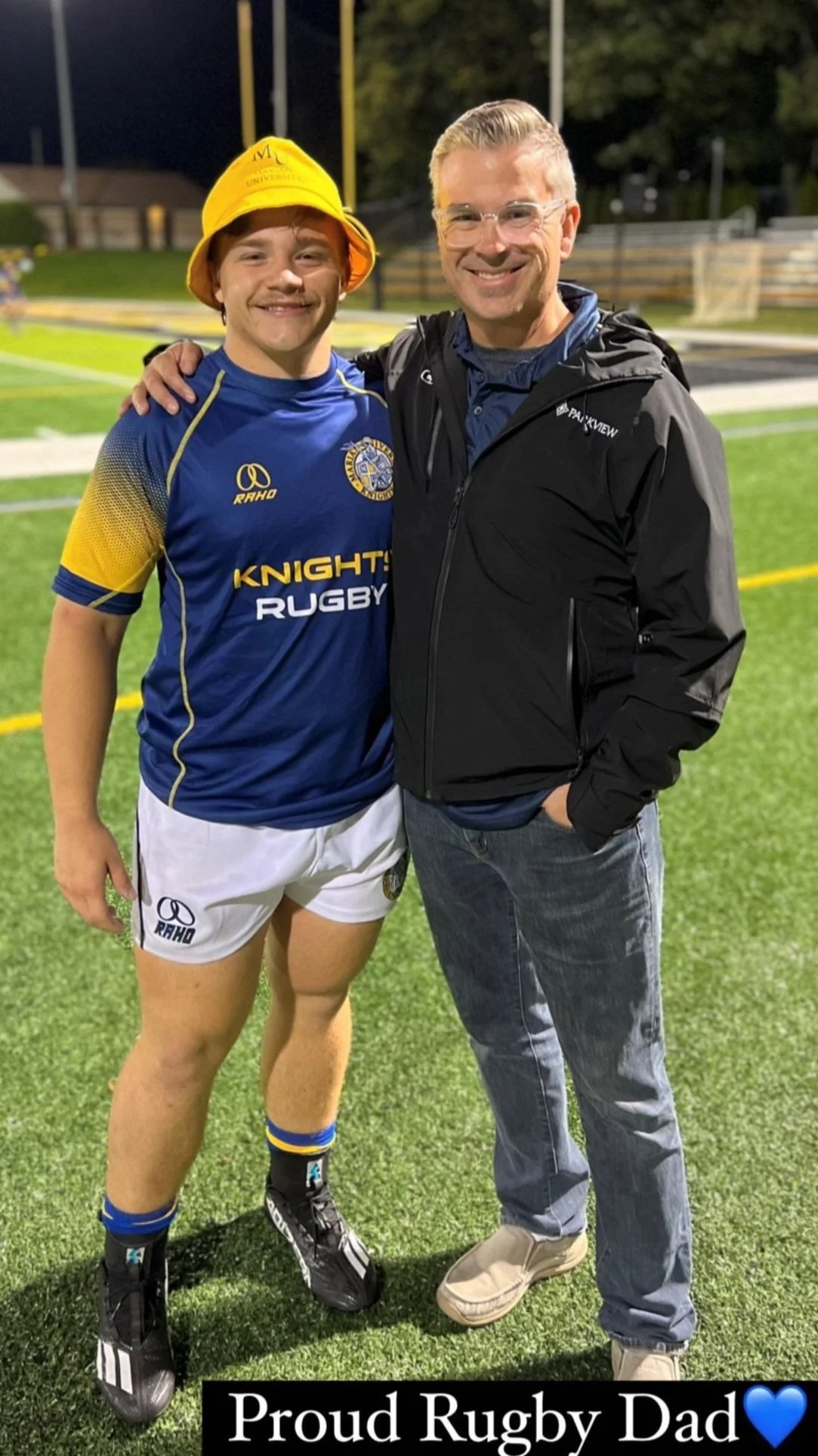
Sometimes, I share the below photo when I speak.
It was taken when I was in a very dark place.
The casual onlooker would never have known.
I am smiling, dressed nice, sporting a fresh haircut, and enjoying the amazing rugby action of the Marian University Knights led by our son, Daniel Riecke.
So, just a reminder that some people who scored a touchdown on MNF, and some people who are leading well at your organization are...
right on the edge.
I got therapy.
I got medication.
I had to make some changes.
And it took years to get to where I am today.
I am glad I made it.
P.S. Kudos to the Colts and Courageous Healing, Inc. with Janell Lane, MA, LMHC and Aaron Lane, MSOL, LSW helping to #kickthestigma.